

Potential Impacts of Wind Farms on Shipping in the Bay of Bothnia
Contact: mailto:
The aim of this pre-study is to provide an initial, evidence-based assessment of the potential interactions between planned OWFs and winter navigation. Specifically, the study seeks to identify where OWF areas overlap with winter shipping routes, examine how these overlaps change under different winter severity conditions, and capture operational concerns and risk perceptions from experienced winter navigation stakeholders.
The analysis combines AIS-based reconstruction of winter ship trajectories with ice-condition data and stakeholder input. Cargo vessels and tankers are analysed using an intersection rate, defined as the percentage of unique vessels whose winter routes intersect each OWF area each winter month. The icebreaker activity is analysed separately. Ice conditions are characterised using Copernicus Marine Service data on ice concentration, thickness, and drift, together with a winter-severity indicator derived from multiple sampling points across key traffic corridors and OWF zones. In parallel, qualitative insights are collected via an online questionnaire and in-depth interviews with shipmasters with experience in winter navigation. The study covers four representative winters, spanning mild, normal, and severe ice conditions.
The results show that traffic in the Bay of Bothnia is consistently concentrated along a limited number of entry and exit corridors that shift geographically in response to ice conditions and wind-driven ice drift. OWF areas located along these dominant corridors experience the highest interaction with winter shipping. Under mild ice conditions, traffic is more dispersed. In contrast, during normal and especially severe winters, routing options become increasingly constrained, leading to pronounced concentration of vessel traffic through specific corridors and, consequently, through certain OWF areas. In contrast, OWF areas characterised by persistently heavy ice tend to experience reduced traffic during severe conditions, as vessels divert toward more navigable coastal or icebreaker-assisted routes.
-
 Svensk sjöfart växer igen
 -
 Sjöfarten når inte sina 2030-mål
 -
 EU:s klimatkrav kan flytta utsläpp från luft till hav
 -
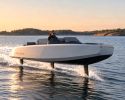 Ny testmetod för foilande fartyg
 -
 DNV: satsa på energieffektivisering och bygg fartyg som klarar fel bränsleval
 -
 Sommarjobb bidrar till att säkra svensk sjöfarts framtida kompetens
 -
 Vad händer när staten behöver hamnen? Se seminariet i efterhand
 -
 Sjöfarten behöver ta större plats på Transportforum 2027 – skicka in abstract innan 30 augusti
 -
 Regeringens maritima strategi lyfter forskningens betydelse – men ger en ofullständig bild av dess finansiering och struktur
 -
 Godsvolymerna till USA ökade trots Trumps tullar


