

Early “eyes on scene” on can save lives

When an alarm about a maritime emergency is raised, the first information that reaches the rescue coordinator is often scarce. To more quickly gain a clear situational picture, “eyes on scene” are therefore needed as early as possible. This is exactly what the Swedish Transport Administration–funded project Eyes On Scene (EOS) has developed, using drone technology.
As soon as an emergency alarm is received, a drone (EOS) is launched from one of the Swedish Sea Rescue Society’s stations along the coast. Even before personnel have boarded a rescue vessel—which on average takes 12 minutes—the drone has already arrived at the scene and streamed video as well as captured high-resolution still images of the situation.
“An early situational picture can reduce various forms of uncertainty and stress and make rescue operations more effective. For example, we may learn that the situation is not quite as urgent, which means we can reduce speed—improving both safety and sustainability. We may also learn that it is better to choose one of our smaller vessels to reach those in distress, which of course makes the process more efficient,” says Fredrik Falkman of the Swedish Sea Rescue Society.
When the Swedish Sea Rescue Society first began exploring the idea of using drones about ten years ago, Fredrik Falkman thought it would be easy to implement. He envisioned flying many small drones at low altitude, where no one else operates, for a good cause.
“These ten years have taught me that it is not easy to make this happen. Regulations have posed significant resistance. And it wasn’t possible, as we initially thought, to simply buy drones and all the equipment we needed—it simply didn’t exist. So we started building parts ourselves, mainly to become better customers once products began to be manufactured. But now we’ve realized that no one is developing what we need, because very few have permits to fly the way we do—and as a result, there is no market for it either.”
Nevertheless, together with project partner RISE (which formally owns the project), as well as Smartplanes, Infotiv, and Remote, the Swedish Sea Rescue Society has come very close to the goal of complementing its search and rescue (SAR) service with early eyes on scene. Outside the facilities in Långedrag, a catapult box stands ready to launch a drone that can then fly at 30 meters per second over the Gothenburg archipelago. This means it can reach ten to twelve nautical miles in about twelve minutes.
“The catapult and the drone are controlled from a computer that can, in principle, be located anywhere. But the system is not yet fully developed and requires a certain amount of manual intervention. It’s the last ten percent that requires 90 percent of the development time.”
Under the current regulatory framework, the project now has permission to fly drones beyond visual line of sight over an area stretching from Tistlarna in the south to Marstrand in the north. However, this requires activation and coordination with several actors, including the military.
“We actually had the drone on standby for a couple of weeks this summer, but no alarm came in. So we still haven’t flown a live mission. However, during the course of the project we have flown more than a thousand kilometers in the archipelago.”
The tests have gone well and show that the system works. Among other things, it has become clear that high-resolution still images provide the rescue teams with the best information. The video stream is mainly used by the pilot controlling the drone, since it is easy to become fixated on and can therefore be distracting. However, several challenges remain, including certification to allow the drone to be flown. So far, only Fredrik Falkman has the necessary permit, and the technology is not yet mature enough to be handed over to the Sea Rescue Society’s volunteer personnel.
There are also regulatory hurdles still to overcome.
“The EU-wide regulations are fundamentally good. But the Swedish Transport Agency, which is the permitting authority, and we in the industry who want to fly drones must together find a way to apply them in practice. Unfortunately, that work is moving somewhat slowly, and it’s difficult to take the step toward commercialization before we know more.”
From a technical standpoint, the system is also not yet sufficiently robust, particularly when it comes to the ability to land the drone on water.
“It’s difficult to completely prevent water from entering the drone, and it’s also not easy to retrieve it from a boat. That’s why we’ve had a couple of master’s theses investigating whether it’s possible to carry out an automatic landing on a rescue vessel. It’s a bit tricky since the drone takes off and lands like an airplane, but it appears that it could work,” says Fredrik Falkman.
The report Eyes on the Scene 2 was authored by Rasmus Lundqvist (RISE), Fredrik Falkman (Swedish Sea Rescue Society), Fredrik Forsman (Chalmers University of Technology), Olle Hagner (Smartplanes/Origon), Alexander Sandström (Remote Aero), Maria Wais (Infotiv), Maria Alemyr (Infotiv), Rego Granlund (RISE), Oskar Bjurling (RISE), and Mikael Brunnström (Smartplanes/Origon).
-
 Svensk sjöfart växer igen
 -
 Sjöfarten når inte sina 2030-mål
 -
 EU:s klimatkrav kan flytta utsläpp från luft till hav
 -
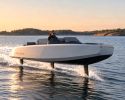 Ny testmetod för foilande fartyg
 -
 DNV: satsa på energieffektivisering och bygg fartyg som klarar fel bränsleval
 -
 Sommarjobb bidrar till att säkra svensk sjöfarts framtida kompetens
 -
 Vad händer när staten behöver hamnen? Se seminariet i efterhand
 -
 Sjöfarten behöver ta större plats på Transportforum 2027 – skicka in abstract innan 30 augusti
 -
 Regeringens maritima strategi lyfter forskningens betydelse – men ger en ofullständig bild av dess finansiering och struktur
 -
 Godsvolymerna till USA ökade trots Trumps tullar


