

New test method for foiling vessels

The pursuit of zero-emission vessels has given hydrofoil technology a major boost. Yet despite growing interest, researchers have lacked reliable methods for measuring how hydrofoils actually perform under real-world conditions. Researchers at RISE and Chalmers have now developed a new testing method that makes it possible to analyze forces and motions with significantly greater precision than before.
When a vessel is equipped with hydrofoils, the hull is lifted out of the water while underway. The result is dramatically reduced hydrodynamic drag, improved energy efficiency, and smaller wake waves. Although the technology has been around since the 1950s, it has experienced a strong resurgence in recent years, driven in part by the development of electric vessels.
"In the past, the technology was used to achieve the highest possible speeds. The focus was on building robust steel systems that were relatively insensitive to maneuvering. But that required a lot of energy and large, powerful engines. Today's electrified and automated systems are designed to save energy, and the foils are lightweight and slender. They are far more sensitive and require completely different computerized control systems to operate effectively," says Alex Shiri, researcher at RISE and leader of the innovation project Safe and Sustainable Sea Transport Through Development of Test Method for Foiling Craft, carried out within the Swedish Transport Administration's industry programme Sustainable Shipping, coordinated by Lighthouse.
For electric vessels, every kilowatt-hour saved matters. By reducing resistance, hydrofoils can increase range and reduce the need for heavy battery packs. As a result, several companies, including Sweden's Candela and Artemis Technologies, are investing in foiling vessels for applications ranging from commuter ferries to workboats.
However, developing the technology is far from straightforward. Hydrofoils operate in a highly complex environment where forces from water, waves and vessel motions interact continuously. Their performance depends on factors such as immersion depth, angle of attack and speed. Simulating all these variables in computer models is both time-consuming and uncertain. At the same time, traditional test facilities have been designed for conventional hulls rather than hydrofoils.
"The goal of the project has been to develop a method that industry can use when designing and developing hydrofoil technology. To achieve this, we designed and built a dedicated hydrofoil test rig at the RISE Maritime/SSPA towing tank in Gothenburg. The rig enables simultaneous measurement of all relevant forces and moments, while the foil's depth, angle and position can be controlled with high precision."
A key innovation is that the rig can also be used for testing in waves, which is crucial because foiling vessels must perform in real sea conditions, not only in calm water.
"The purpose is to validate the results of computer simulations when developing new foiling technologies. By comparing simulations with real measurement data, designers can adjust and improve their solutions. This will be extremely valuable for them. Today, there is no established standard for how hydrofoils should best be designed and integrated into a vessel. Many questions remain unanswered: Where should hydrofoils be placed? At what speeds do they perform optimally? How should they be controlled and regulated? Is it better to use one hydrofoil or several, and how do they interact? The new testing environment gives researchers and developers an opportunity to investigate such questions in a much more systematic way," says Alex Shiri.
As part of the project, relatively large, commercially available carbon-fibre hydrofoils were tested instead of small-scale models. Hydrofoil boat builder Aston Harald, for example, contributed a custom-built carbon-fibre foiling research platform. The 1.8-metre model vessel is now being used by RISE/SSPA for continued studies of hydrofoil performance, control systems and autonomous functions.
The project therefore delivers not only a new testing methodology but also a practical research platform for developing the next generation of energy-efficient foiling vessels.
The report Safe and Sustainable Sea Transport Through Development of Test Method for Foiling Craft was authored by Alex Shiri (RISE) and Arash Eslamdoost (Chalmers).
In collaboration with KTH, SSRS and Aston Harald.
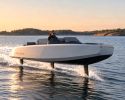
Photo: Candela
-
 9,5 meter hög mast säkrar vätgasdrift
 -
 Svårt att jämföra sjöfartens klimatmodeller
 -
 Se seminariet Could nuclear power become part of the future of Swedish shipping?
 -
 Svensk sjöfart växer igen
 -
 Sjöfarten når inte sina 2030-mål
 -
 EU:s klimatkrav kan flytta utsläpp från luft till hav
 -
 Ny testmetod för foilande fartyg
 -
 DNV: satsa på energieffektivisering och bygg fartyg som klarar fel bränsleval
 -
 Sommarjobb bidrar till att säkra svensk sjöfarts framtida kompetens
 -
 Vad händer när staten behöver hamnen? Se seminariet i efterhand


