

Biofouling on Antifouling Coatings under Static and Dynamic Conditions
Contact:
One challenge within this field of research is that knowledge from several disciplines needs to be combined to perform dynamic studies of antifouling coatings. The characterization of the hydrodynamic conditions is needed for useful comparisons between different test setups (both in lab and field). Another challenge lies in the application of results from test conditions (biofouling roughness) when translated to the predicted impact for a moving ship. The biofouling consists of both hard and soft, living and growing marine organisms, and can therefore not directly/in a simple way be translated into a roughness coefficient to be used further in hydrodynamic modelling.
The process of biofouling takes place in the interphase between water and the hull surface under flow conditions and all aspects that will impact this process are of importance. This requires collaboration between several fields of research like marine ecology, ecotoxicology, surface/interphase chemistry, fluid dynamics, optimally also with data from paint producers and naval architects at hand. Understanding of the hydrodynamic forces that impact a larvae (for example a barnacle larvae) when approaching a surface is crucial. However, there are multitudes of marine organisms with an “attached lifeform” (attached way of life) with different forms of larval stages, of different size, ability to swim and various attachment structures. Knowledge of several processes: attachment mechanism and adhesion strength, tolerance to toxins and surface characteristics, duration of larval stage, swimming or “propelling” capacities together with the character of the surrounding hydrodynamic/flow conditions and their correlated forces, are needed for the complete picture.
-
 Svensk sjöfart växer igen
 -
 Sjöfarten når inte sina 2030-mål
 -
 EU:s klimatkrav kan flytta utsläpp från luft till hav
 -
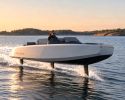 Ny testmetod för foilande fartyg
 -
 DNV: satsa på energieffektivisering och bygg fartyg som klarar fel bränsleval
 -
 Sommarjobb bidrar till att säkra svensk sjöfarts framtida kompetens
 -
 Vad händer när staten behöver hamnen? Se seminariet i efterhand
 -
 Sjöfarten behöver ta större plats på Transportforum 2027 – skicka in abstract innan 30 augusti
 -
 Regeringens maritima strategi lyfter forskningens betydelse – men ger en ofullständig bild av dess finansiering och struktur
 -
 Godsvolymerna till USA ökade trots Trumps tullar


