

Safe and Sustainable Sea Transport Through Development of Test Method for Foiling Craft
Contact:
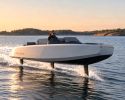
The growing demand for sustainable and energy efficient marine transportation, driven by advances in electric propulsion and increasing environmental concerns, has led to renewed interest in hydrofoil technology. By lifting the hull out of the water during transit, hydrofoils can dramatically reduce hydrodynamic resistance, enabling higher efficiency, extended operational range, reduced noise emissions, and improved passenger comfort. These characteristics make foiling craft particularly attractive for electric ferries, high speed service vessels and autonomous craft.
Despite their significant potential, the hydrodynamics and dynamic behaviour of foiling craft remain insufficiently understood. Hydrofoils operate in a highly dynamic and complex environment involving strong interactions between the foil, free surface, hull, and waves. Key challenges include accurate prediction of lift and drag across relevant operating conditions, foil behaviour in waves, foil ventilation, operation close to free-surface and near failure scenarios such as sudden descents. Furthermore, unlike displacement vessels, hydrofoil performance depends strongly on both submergence and Reynolds number, making conventional Froude based scaling procedures inadequate. The lack of established testing guidelines and scaling methodologies has limited the effectiveness and reliability of experimental investigations.
Previous experimental studies at the RISE Maritime/SSPA facilities have examined hydrofoil performance through towing tank measurements, cavitation tunnel investigations of fluid‑structure interaction, and foiling model boat tests conducted within academic and applied research projects. However, because existing towing tank configurations are optimized for conventional hull testing, these studies required improvised mounting solutions and test rigs. This increased cost, complexity and, in some cases, compromised measurement accuracy due to structural compliance, limited measurement capability, and insufficient control of foil position and angle of attack.
To address these challenges, the present project focuses on the development of tailored experimental methods and dedicated measurement rig for hydrofoil testing. A new test rig has been designed and manufactured to enable accurate measurement of all relevant force and moment components while allowing precise control and monitoring of foil submergence, motion, and angle of attack. Full scale hydrofoils are tested to reduce Reynolds number scaling uncertainties, and a systematic test matrix is conducted in the RISE Maritime/SSPA towing tank using multiple foil sizes, submergence conditions, and operating conditions. Both calm water condition and response to regular waves in head and following seas are investigated. The results are presented together with an assessment of dominant contributors to measurement uncertainties.
-
 Svensk sjöfart växer igen
 -
 Sjöfarten når inte sina 2030-mål
 -
 EU:s klimatkrav kan flytta utsläpp från luft till hav
 -
 Ny testmetod för foilande fartyg
 -
 DNV: satsa på energieffektivisering och bygg fartyg som klarar fel bränsleval
 -
 Sommarjobb bidrar till att säkra svensk sjöfarts framtida kompetens
 -
 Vad händer när staten behöver hamnen? Se seminariet i efterhand
 -
 Sjöfarten behöver ta större plats på Transportforum 2027 – skicka in abstract innan 30 augusti
 -
 Regeringens maritima strategi lyfter forskningens betydelse – men ger en ofullständig bild av dess finansiering och struktur
 -
 Godsvolymerna till USA ökade trots Trumps tullar


